Research Themes
The objective of the Target team is to elucidate the molecular mechanisms underlying therapeutic resistance in order to develop novel treatment strategies. Our research primarily focuses on non-small cell lung cancer (NSCLC), small cell lung cancer (SCLC), and prostate cancer (PCa). Although the mechanisms driving tumorigenesis and therapeutic resistance differ among these three cancer types, the team addresses these challenges using common conceptual and methodological approaches.
Targeting Receptor Tyrosine Kinases in Non-Small Cell Lung Cancer
PIs: David Tulasne, Anne Chotteau-Lelièvre, Marie-José Truong, Zoulika Kherrouche, Alexis Cortot, Sarah Humez
Non-small cell lung cancer (NSCLC) is characterized by the presence of genomic alterations that may lead to oncogene addiction, a situation in which cancer cell proliferation and/or survival depends on a single oncogene. These alterations affect several receptor tyrosine kinases (RTKs), leading to their activation. Consequently, tyrosine kinase inhibitors (TKIs) represent the majority of targeted therapies used in NSCLC. These targeted therapies are currently transforming patient management, with a significant improvement in life expectancy.
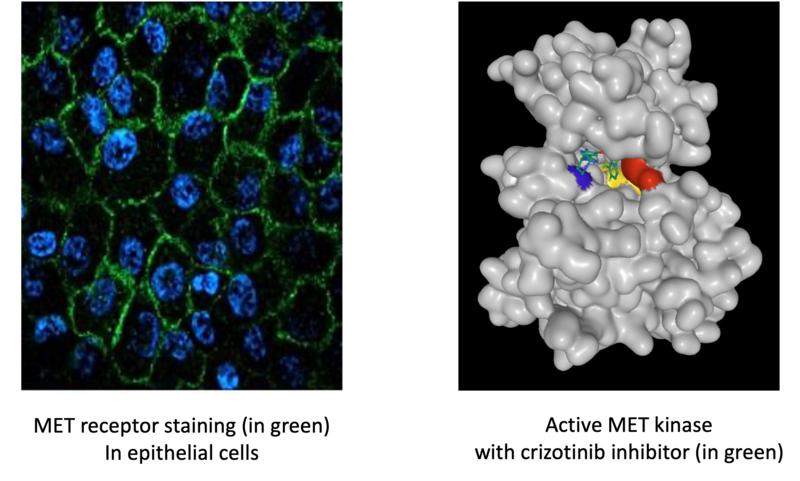
Although targeting several RTKs has yielded highly satisfactory results, clinical outcomes are more mixed for others. In this context, the efficacy of therapies targeting the MET receptor remains modest, and the mechanisms involved in inducing tumorigenesis have not yet been fully elucidated.
Accordingly, the main objectives of the Target team are (i) to gain a deeper understanding of the mechanisms underlying oncogene addiction, which may help identify patients who are likely to respond to treatment, (ii) to anticipate the mechanisms of resistance that lead to relapse, and (iii) to expand the population of patients eligible for these targeted therapies.
Overall, our work over the past several years has enabled us to decipher the mechanisms of MET-induced oncogene addiction and has provided further support for the use of TKIs in patients presenting activation of this receptor. Our expertise has also led us to challenge established paradigms, including through the discovery of the apoptotic properties of MET, revealing its role as a tumor suppressor in addition to its oncogenic function, as well as the involvement of its internalization in the control of signaling. We are also investigating new targeted therapies directed against RTKs, including antibody-drug conjugates (ADCs), whose mechanisms of action have so far been only poorly linked to receptor biology.
To address these challenges, we rely on a translational research team that benefits from the unique contribution of patient cohorts managed at Lille University Hospital (CHU de Lille), a leading institution in clinical research.

Drug-Resistance in Small Cell Lung Cancer
Understand and Overcome Drug-Resistance in Small Cell Lung Cancer
Small cell lung cancer (SCLC) is a highly aggressive form of lung cancer with a particularly poor prognosis. Although SCLC is initially highly sensitive to platinum-based chemotherapy, with response rates of 60-70%, this response is almost invariably followed by rapid disease recurrence due to the emergence of treatment-resistant cancer cells. Therapeutic options after relapse remain extremely limited.
Our research aims to uncover the mechanisms that enable SCLC cells to survive therapy and drive relapse. We investigate two complementary models of acquired drug resistance: (i) the selection of pre-existing genetically resistant cell populations and (ii) the presence of treatment-tolerant persister cells that constitute a reservoir of cancer cells capable of surviving cancer therapy long enough to develop genetic alterations that confer stable drug resistance.
By defining how these resistant cell populations emerge and evolve, we seek to identify novel therapeutic strategies that prevent relapse and improve long-term outcomes for patients with SCLC.