Research themes
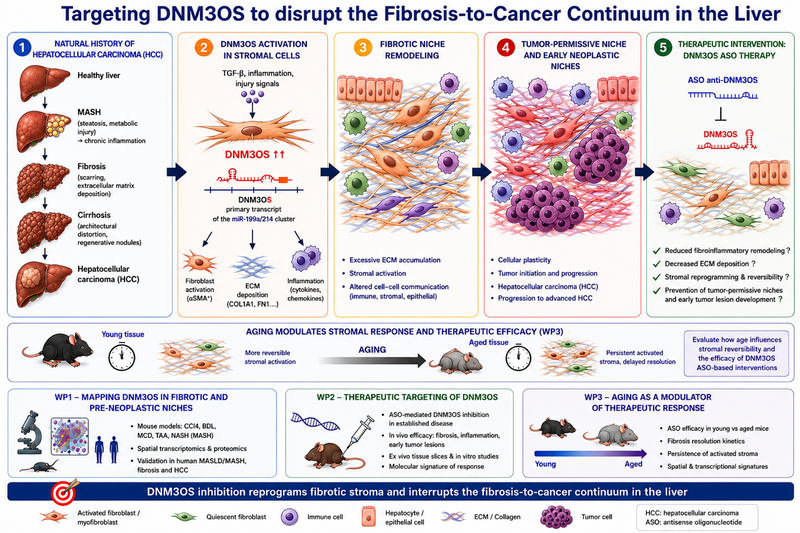
Our work has identified the long non-coding RNA DNM3OS as a key regulator of tissue fibrosis. Its expression is increased in multiple fibrotic contexts, including the lung, kidney, and liver (Savary et al., 2019 ; Fellah et al., 2022 ; Fellah, 2023). DNM3OS is mainly expressed by activated fibroblasts and is regulated by major pro-fibrotic pathways such as TGF-β signaling. Targeting DNM3OS using antisense oligonucleotides efficiently attenuates fibrosis in several experimental models, positioning DNM3OS as a broad pro-fibrotic driver across organs.
Since certain cancers, including hepatocellular carcinoma, preferentially arise in a fibrotic environment, we will test the hypothesis that inhibiting DNM3OS—by limiting the establishment of a permissive fibrotic microenvironment—may restrict or delay tumor initiation.
This project aims to understand how the age-related accumulation of senescent cells impairs the resolution of pulmonary fibrosis. Using single-cell and spatial transcriptomics analyses, we have shown that fibrosis resolution is delayed in aged mice and is associated with specific alterations in capillary endothelial cell subpopulations, particularly Lrg1⁺ cells, whose transcriptional signatures differ between young and aged animals during the repair phase (Truchi et al., 2025). To elucidate the functional role of senescence in these processes, we will combine an approach enabling the visualization and tracking of senescent cells during fibrosis with pharmacological strategies aimed at eliminating senescent cells or modulating their phenotype. The objective is to determine how senescence disrupts tissue repair mechanisms and to identify new therapeutic targets capable of restoring age-related pulmonary fibrosis resolution.
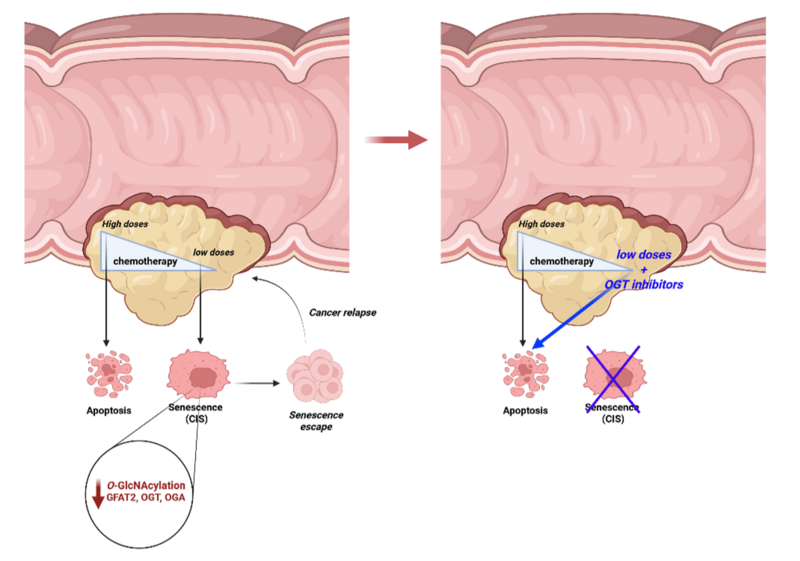
Colorectal cancer (CRC) remains a leading cause of cancer-related mortality, partly due to the emergence of drug-tolerant persister cells (DTPs). These cells can enter a transient senescent state and subsequently resume proliferation, thereby promoting tumor relapse. O-GlcNAcylation, a post-translational modification catalyzed by OGT, is overexpressed in colorectal cancer cells. Our recent findings suggest that inhibiting this modification may limit both the emergence and escape of these senescent DTPs (Loison et al., 2024; Pioger et al., 2025). This project is structured around three complementary aims. The first is to validate, in different preclinical models, the impact of OGT inhibition on the efficacy of FOLFIRI chemotherapy used in advanced CRC. The second, mechanistic aim is to identify molecular targets regulated by O-GlcNAcylation that control senescence induction and escape. The third, conducted in collaboration with Professor Sophie Dabo and Dr Alexandre Poulain (Paul Painlevé Laboratory), aims to use mathematical modeling to predict the dynamics of senescent DTPs and optimize a combinatorial strategy combining OGT inhibition with FOLFIRI chemotherapy.
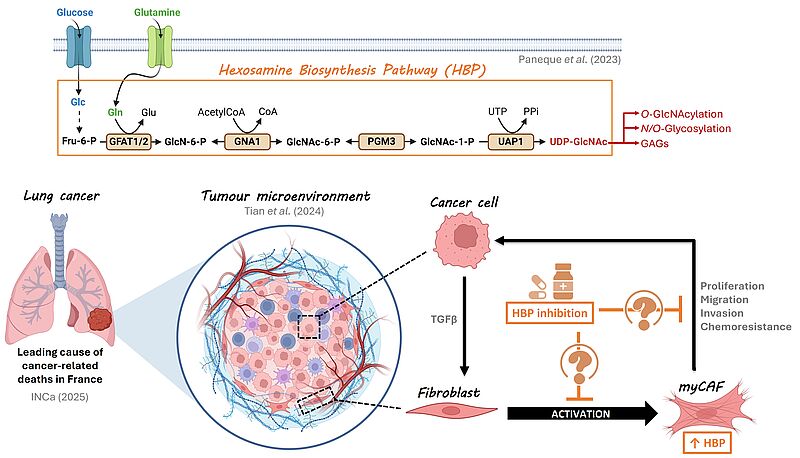
Lung cancer remains the leading cause of cancer-related death in France. Cancer-associated fibroblasts (CAFs), and particularly myCAFs derived from TGFβ-activated pulmonary fibroblasts, play a key role in tissue remodeling, immune modulation, and tumor progression, thereby promoting cancer cell proliferation, migration, invasion, and chemoresistance. Our preliminary results show that fibroblast activation into myCAFs is associated with an upregulation of the hexosamine biosynthetic pathway (HBP), a metabolic pathway generating UDP-GlcNAc, a key substrate for multiple glycosylation processes including O-GlcNAcylation. This project aims to investigate the potential role of the HBP in the pro-tumoral functions of myCAFs, their contribution to chemoresistance, and to evaluate the therapeutic potential of its modulation.
This axis is based on the study of the role of the senescent tumor microenvironment (including the SASP) in promoting cancer initiation and progression. We aim to perform in situ analyses of SASP molecules secreted by senescent fibroblasts within a pro-carcinogenic microenvironment, using biological samples from aged human skin. We will reproduce molecular gradients and manipulate them within a biological twin using a 3D BioMEMS (Bio-Microelectromechanical Systems) microdevice. These approaches will feed and enrich a digital skin twin in an aging context, ultimately enabling the modeling of probable sequences contributing to cancer progression in initiated keratinocytes. This platform will also allow the simulation and testing of therapeutic strategies targeting senescent cells or their SASP, which can then be validated in the 3D biological model. https://doi.org/10.1051/mmnp/2026002.
Our research focuses on cellular senescence, a state of strong proliferation arrest induced by various stressors such as DNA damage, oxidative stress, ultraviolet (UV) radiation, and oncogene activation. Far from being a static state, senescence is a dynamic process that profoundly influences the microenvironment through a complex secretome known as the SASP (Senescence-Associated Secretory Phenotype). Our work aims to determine the molecular mechanisms controlling the establishment of this phenotype and its impact on aging and cancer through two major axes :
1. The UPR : A central signaling platform for senescence
We have identified the Unfolded Protein Response (UPR), triggered by endoplasmic reticulum (ER) stress, as a central signaling hub that controls the establishment and maintenance of major senescence characteristics. We have specifically demonstrated that the ATF6α branch of the UPR dictates the morphological remodeling of the aging cell, including cell enlargement, and the expansion of the ER. Silencing ATF6α in already senescent fibroblasts allows them to regain a healthy fusiform shape, suggesting that morphological traits of aging are potentially reversible. We want to develop "senomorphic" strategies that restore tissue functionality without compromising the beneficial roles of senescent cells.
2. Senescence evasion and tumor initiation
While senescence is primarily an anti-tumor barrier, some cells can escape this state to give rise to pre-neoplastic cells : a process we call post-senescence neoplastic emergence (PSNE). We explore the mechanisms favoring this switch, notably the PTGS2/PGE2/EP (prostaglandin) pathway, which acts as a driver of tumor evasion. Conversely, we have shown that the activation of the PERK and ATF6α branches of the UPR acts as a protective barrier that limits this malignant transformation. We want to establish the relationship between UPR and the prostaglandin pathway and determine whether their pharmacological modulation effectively block the transition from protective senescence to malignant transformation in aged epithelia.
Our research focuses on the Unfolded Protein Response (UPR), a sophisticated adaptive signaling network triggered by Endoplasmic Reticulum (ER) stress. In the context of malignancies like Adenocarcinoma of the Gastroesophageal Junction (ACGEJ), tumor cells hijack this "proteostasis rheostat" to survive hostile microenvironments, drive proliferation, and resist conventional therapies. By integrating multi-omic signatures, mechanistic cell biology, and clinical data from the FREGAT cohort, we aim to transform our understanding of the UPR from a descriptive biological process into a predictive tool for precision oncology.
Research Axis 1: Multigenic UPR signatures for clinical stratification
We utilize large-scale transcriptomic and proteomic data to move beyond single-marker snapshots, developing multigenic UPR signatures that capture the functional state of the ER. Our work in ACGEJ has identified specific signatures (including markers like GRP78, GRP94, and AGR2) that distinguish treatment-naive tumors from those responsive to preoperative chemotherapy. Our goal is to determine if these signatures can be standardized as robust clinical tools to identify patients with specific "proteostatic vulnerabilities" likely to benefit from targeted adjuvant modulation.
Research Axis 2: Mechanistic dissection of the IRE1α/AGR2/EGFR axis
A major focus of our laboratory is the characterization of the IRE1α-XBP1s / AGR2 / EGFR signaling cascade. We have demonstrated that the ER-resident protein AGR2 is a direct transcriptional target of the IRE1α branch and serves as a critical chaperone that stabilizes oncogenic receptors like EGFR. We want to determine in what extent can the dual inhibition of the IRE1α RNase activity and EGFR signaling provide a synergistic therapeutic window to overcome resistance in AGR2-high aggressive tumors.
Research Axis 3: Non-invasive biomarkers and secretome remodeling
We explore how the UPR reshapes the tumor secretome, leading to the release of ER-resident proteins into the extracellular space and systemic circulation. By analyzing patient sera and cell culture supernatants via mass spectrometry, we are identifying circulating biomarkers that reflect the intracellular stress status of the tumor. This research aims to develop high-fidelity tools that monitor the tumor's "proteostatic state" and therapeutic response in real-time, offering a non-invasive alternative to traditional tissue biopsies.