Technologies
Preclinical illumination device – in vitro
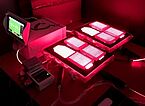
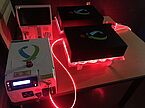
As part of the projects conducted on the understanding of the mechanism of action of photodynamic therapy, ONCOTHAI team have developed light plates allowing the illumination of flasks or cell boxes.
These plates are made of light emitting fabrics delivering a homogeneous distribution of light on a surface area of 630 cm² per plate. The irradiance can reach several mW / cm². Two wavelengths are now available: 635 and 670 nm.
Opaque covers prevent exposure to stray light.
Preclinical illumination device - in vivo
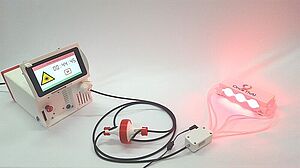
As part of the PRODYNOV project, ONCOTHAI has developed a mouse illumination device that will be used in in vivo studies about the PDT treatment of “nude” mice with peritoneal carcinomatosis of ovarian origin.
In practice, flexible light emmitting fabrics have been placed on a corrugated plastic base allowing a homogeneous illumination of the entire body of the mouse (except the head).
Light Emitting Fabrics (LEF)
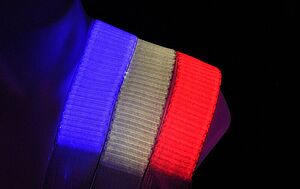
In partnership with TEXINOV, which manufactures Light Emitting Fabrics (LEF) using a patented process, ONCOTHAI has developed various flexible and conformable illumination devices used in human clinics and also in experimental research.
These textile devices can emit throughout the visible and near infrared spectrum with irradiances up to 25 mW/cm² without any heating.
Numerical simulations
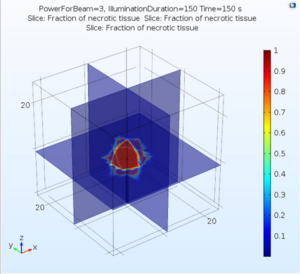
Treatments developed in the ONCOTHAI laboratory require numerous computer simulations. Optimization of therapy delivery parameters, planning (preoperative), real-time monitoring (intraoperative) and treatment validation (postoperative) define one of the fields of expertise of the laboratory, namely dosimetry.
These various modeling allow to quantify the impact of the light on illuminated tissues during a treatment. Numerical modeling softwares (COMSOL© Multiphysics) or mathematical computations (Matlab©) are used as technical support for the development of computer models for the improvement of therapies delivery.
Optic
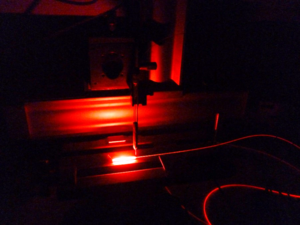
ONCOTHAI has already initiated several clinical studies carried out at the University Hospital of Lille. They aim to evaluate the feasibility and effectiveness of photodynamic therapy in the management of various neoplastic pathologies.
Light is an essential element for the setup of photodynamic therapy, and validation of the illumination modalities required for its application in human clinical application remains one of the major axes of the research program of unit ONCOTHAI.
The combination of electronics and computer science with precision optics allows to characterize the light performances (power, wavelength, spatial profile) of laser devices developed in the laboratory.
For each device developed, the homogeneity and the illumination efficiency are determined in a standard situation, on the optical benches of the laboratory, based on the principles of metrology. For each medical application, the light emitting device is applied to a physical model of cavity (thoracic, or cerebral for example) or superficial (skin, mucous membranes). These models make possible to map the light delivered by the device and to check the maintenance of its optical performance during the application.
Myrian®, Intrasense
The visualization and medical image processing platform Myrian® enables the development of numerous applications dedicated to the clinic.
Based in Montpellier, France, Intrasense offers this solution integrating a large number of standard functionalities used in medical imaging. This complete environment has therefore been chosen to host and integrate our computer developments dedicated to the planning of photodynamic treatments, i.e. the interstitial treatment with the insertion of optical fibers within the tumor.Optical fibers can be modeled on medical images to plan their insertion. A light dose computing of each fiber is achieved to optimize the delivery of the treatment (types of fibers used, power and illumination time delivered by the laser).
More information on Myrian® : http://www.intrasense.fr/fr/myrian/
3D printing
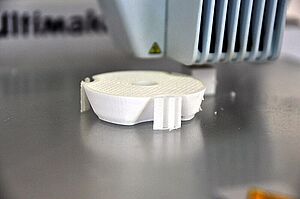
The ONCOTHAI team has a strong expertise in the field of 3D printing. This expertise allows the autonomy in the design and manufacture of prototypes, as well as technical support for the various experiments carried out within the laboratory.
After the realization of a computer object with the use of computer-aided design software, this one is reworked to integrate the mechanical constraints encountered during its printing. Several properties (optical and mechanical) can be simulated depending on the type of material and mesh used during printing.
The high flexibility and speed of printing make this technology a major asset in the realization of the various research projects of the lab.
ArtiMED: a medical imaging collaborative platform
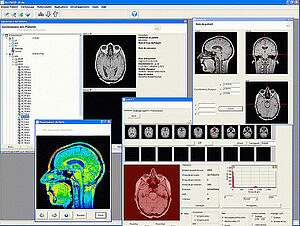
The ArtiMED project has been setup since the first informatics developments realized at the laboratory. The absolute requirement of unifying all the software developments has been formalized through a tools kit for medical imaging applications.
The very large range of ArtiMED functionalities includes low level tools as system tools (system management, 2-D and 3-D graphical tools…) or mathematics tools (matrix computing, optimization, FFT, 3-D geometry, statistical tools,…), a complete compatibility with the different standards as ACR-NEMA 2.0, DICOM 3.0, DICOM RT, the management of a patient data base directly integrated to the system, a large image processing library (filtering, rigid and non rigid transformation, segmentation tools,…) and the management of vectorial objects. General applications are also available from the regular version of ArtiMED such as MPR (Multi-Planar Reconstruction), MIP (Maximum of Intensity of Projection), 3-D reconstruction or image registration. The software development toolkit includes also a RAD (Rapid Development Application) et an intranet site updated with each new versions allowing easy access to the latest versions and to the technical documentations.
Because there is a transversal utilization by all the actors of the Team, ArtiMED is always in evolution, by integrating all the newest developments made by the researchers. This facilitates the information transfer and the perennially of the different works implemented. ArtiMED is already used in numerous clinical applications ArtiMED also includes a programming mode based on the « data flow » architecture which enables to non-programmer users to create evolutionary image processing tools and applications in using block diagram interface.