Research Themes
Engineering Tumors-on-Chip
How can we faithfully reproduce the complexity of a human tumor without observing it directly inside the body? How can we recreate its microenvironment, cellular interactions, and responses to treatment in a controlled experimental setting? These questions drive one of the team's major research themes.
Our research focuses on the development of next-generation experimental models that better reflect the biological complexity of human cancers. By combining three-dimensional cell culture, patient-derived organoids, microfluidic technologies, and advanced bioengineering approaches, we aim to recreate the tumor microenvironment as accurately as possible.
These innovative models enable the study of dynamic interactions between cancer cells, stromal cells, and the surrounding microenvironment with unprecedented precision. They also provide powerful platforms for investigating tumor progression, understanding mechanisms of therapeutic resistance, and evaluating the efficacy of new treatment strategies in conditions that closely mimic patient biology.
By integrating expertise in cancer biology, tissue engineering, and microtechnology, our team is developing physiologically relevant and predictive models that bridge the gap between conventional in vitro systems and clinical reality. These advanced platforms support both fundamental research and translational applications, contributing to the development of more effective and personalized cancer therapies.
Working within this research theme means joining a highly interdisciplinary environment where biologists, engineers, clinicians, and translational researchers collaborate to design innovative experimental models and accelerate discoveries that can ultimately benefit patients.
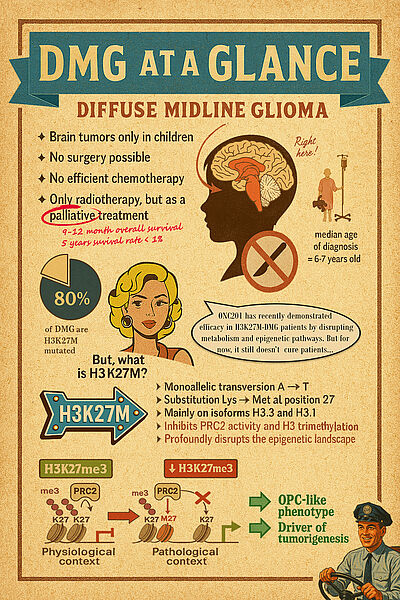
Why do certain pediatric gliomas remain among the most difficult cancers to treat? Which molecular and epigenetic mechanisms enable these tumors to grow, adapt, and resist current therapies? These questions define one of the team's major research themes.
Our research focuses on understanding the biological mechanisms driving the initiation, progression, and therapeutic resistance of diffuse midline gliomas (DMGs), rare but highly aggressive pediatric brain tumors. By integrating cancer biology, pharmacology, molecular biology, and epigenetics, we investigate how genetic and epigenetic alterations reprogram tumor cells and shape their interactions with the tumor microenvironment.
To address these challenges, we combine state-of-the-art multi-omics technologies with advanced experimental models to characterize tumor evolution, identify molecular vulnerabilities, and better understand the mechanisms underlying treatment resistance. These complementary approaches provide valuable insights into the biology of pediatric brain tumors while revealing new opportunities for targeted therapeutic interventions.
By bringing together expertise in functional genomics, epigenetics, and translational cancer research, our team aims to generate clinically relevant knowledge that will accelerate the development of more effective and personalized therapies for children affected by these devastating cancers.
Working within this research theme means contributing to an interdisciplinary and collaborative research environment where fundamental discoveries are closely connected to translational applications, with the shared goal of improving the care and prognosis of pediatric cancer patients.
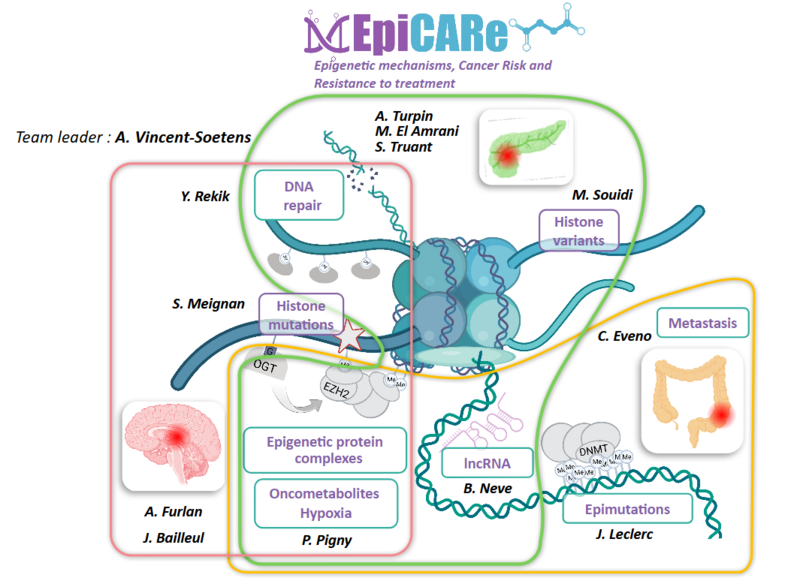
How can cells regulate their behavior without changing their DNA sequence? Which molecular mechanisms control gene expression and contribute to cancer development and therapeutic resistance? These questions represent one of the team's key research themes.
Our research explores the fundamental role of non-coding RNAs and epigenetic regulation in cancer biology. Although these RNA molecules do not encode proteins, they are now recognized as critical regulators of gene expression, cellular communication, and adaptation to environmental cues. Their dysregulation has been implicated in numerous pathological processes, particularly tumor initiation, progression, and resistance to therapy.
By combining molecular biology, transcriptomics, epigenetics, and functional genomics, we investigate how non-coding RNAs interact with complex regulatory networks to influence tumor cell behavior. Our goal is to decipher the molecular mechanisms underlying therapeutic resistance and identify novel biomarkers and therapeutic targets that could improve patient management.
Through the integration of advanced genomic technologies and innovative experimental approaches, our team aims to better understand the multilayered regulation of gene expression and its impact on cancer progression. These studies contribute to the development of new strategies for precision oncology and personalized medicine.
Working within this research theme means joining a dynamic research environment at the forefront of RNA biology and cancer epigenetics, where fundamental discoveries pave the way for innovative therapeutic approaches and improved patient outcomes.
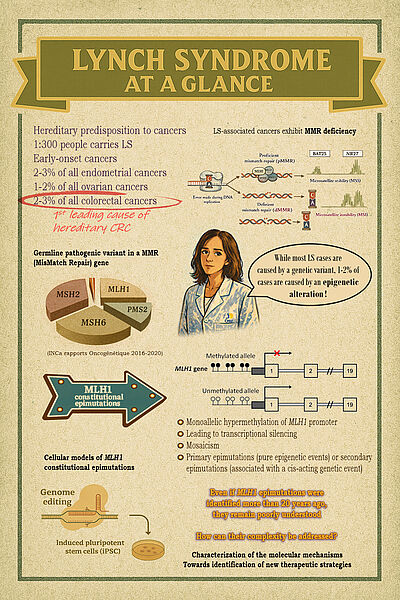
Why do some individuals and families have a significantly higher lifetime risk of developing cancer? How do inherited genetic and epigenetic alterations contribute to tumor initiation and progression? These questions are central to one of the team's major research themes.
Our research focuses on deciphering the molecular mechanisms underlying hereditary cancer predisposition, with a particular emphasis on Lynch syndrome, the most common inherited cause of colorectal cancer and a major risk factor for several gastrointestinal and gynecological malignancies. By investigating the biological consequences of inherited defects in DNA mismatch repair pathways, we aim to better understand how genomic instability drives tumor development and influences disease progression.
Combining expertise in cancer genetics, molecular biology, epigenetics, and translational research, our team explores the mechanisms linking inherited genetic alterations to cancer susceptibility. Through the integration of molecular analyses, genomic technologies, and clinically relevant models, we seek to identify biomarkers that improve risk assessment, facilitate early diagnosis, and refine patient stratification.
Our research is closely connected to clinical practice, supporting the development of precision medicine approaches that enhance cancer prevention, screening, surveillance, and personalized management for patients and at-risk families. By bridging fundamental research with molecular diagnostics and clinical applications, we contribute to translating scientific discoveries into tangible benefits for patient care.
Working within this research theme means joining an interdisciplinary environment where genetics, epigenetics, and translational oncology converge to address major public health challenges and improve outcomes for individuals with hereditary cancer predisposition.
How can biological discoveries be transformed into clinically useful tools for cancer diagnosis, prognosis, and patient monitoring? How can metabolic alterations reveal novel biomarkers and contribute to more personalized therapeutic strategies? These questions define one of the team's major research themes.
Our research focuses on the identification, characterization, and clinical validation of biomarkers associated with cancer development, progression, and treatment response. By investigating tumor metabolism and its molecular consequences, we aim to uncover biological signatures that improve disease detection, patient stratification, and therapeutic decision-making.
A particular area of interest is the study of oncometabolites, including succinate and fumarate, whose abnormal accumulation profoundly alters cellular physiology. Beyond their role as intermediates of the Krebs cycle, these metabolites regulate epigenetic mechanisms, influence cell differentiation, and promote tumor progression, making them promising biomarkers as well as potential therapeutic targets.
By integrating metabolomics, circulating biomarkers, molecular profiling, and clinical data, our team seeks to better understand tumor heterogeneity and identify predictive indicators of disease evolution and treatment response. This multidisciplinary approach supports the development of innovative diagnostic and prognostic tools that contribute to precision oncology and personalized patient care.
Working within this research theme means participating in translational research that bridges fundamental cancer biology with clinical practice, transforming laboratory discoveries into tangible advances for diagnosis, prognosis, therapeutic monitoring, and the development of more effective, patient-centered cancer management strategies.
How do cancer cells colonize the peritoneum? Why do peritoneal diseases progress differently from one patient to another? How can more effective therapeutic strategies be developed for these complex malignancies? These questions represent one of the team's major research themes.
Our research focuses on understanding the biological mechanisms underlying peritoneal metastasis, disease progression, and therapeutic response. Peritoneal malignancies remain a major clinical challenge due to their biological complexity, limited treatment options, and considerable interpatient heterogeneity. By investigating the cellular and molecular processes that drive peritoneal dissemination, we aim to identify new opportunities for earlier diagnosis and more effective therapeutic interventions.
Combining expertise in cancer biology, translational research, surgery, and bioengineering, our team develops advanced experimental models that closely reproduce the peritoneal tumor microenvironment. These innovative platforms allow us to investigate tumor-stroma interactions, mechanisms of metastatic spread, and responses to emerging therapies under physiologically relevant conditions.
Our research is strongly driven by clinical needs, integrating patient-derived samples, molecular analyses, and translational approaches to bridge the gap between laboratory discoveries and clinical practice. This multidisciplinary strategy supports the development of novel diagnostic tools, predictive biomarkers, and personalized therapeutic approaches for patients with peritoneal diseases.
Working within this research theme means joining a collaborative and multidisciplinary environment where clinicians, biologists, engineers, and translational scientists work together to better understand peritoneal malignancies and accelerate the development of innovative strategies aimed at improving patient outcomes and quality of life.
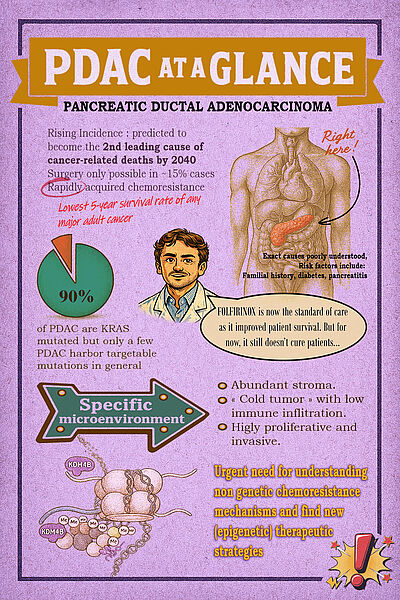
How do cancer cells reprogram their identity to promote tumor progression and evade therapy? Which epigenetic mechanisms control cellular plasticity and shape the aggressiveness of pancreatic cancer? These questions define one of the team's major research themes.
Our research focuses on understanding how epigenetic regulation and chromatin organization influence cellular identity, tumor progression, and therapeutic resistance in pancreatic ductal adenocarcinoma (PDAC). As one of the most aggressive and treatment-resistant malignancies, PDAC represents a major challenge in cancer research, requiring a deeper understanding of the molecular mechanisms driving its evolution.
A central aspect of our work investigates the role of chromatin regulators, including the histone variant macroH2A, in controlling three-dimensional genome organization and gene expression. By modulating chromatin accessibility and nuclear architecture, these epigenetic regulators orchestrate cellular plasticity and influence key biological processes such as the epithelial-to-mesenchymal transition (EMT), a critical step in tumor invasion, metastasis, and resistance to therapy.
By combining molecular biology, epigenetics, functional genomics, and advanced experimental models, our team seeks to decipher the mechanisms linking chromatin dynamics to cancer cell behavior. These studies aim to identify novel molecular vulnerabilities and therapeutic targets that could improve the treatment of pancreatic cancer.
Working within this research theme means joining an interdisciplinary research environment dedicated to understanding how epigenetic mechanisms govern tumor evolution, with the ultimate goal of translating these discoveries into innovative therapeutic strategies for patients with pancreatic cancer.
The development of organoid culture at the University of Lille began in 2015 through the pioneering work of Dr. Isabelle Van Seuningen's team (JPArc/CANTHER), which investigated mechanisms of cancer resistance to therapy. At the same time, Dr. Audrey Vincent (Inserm Research Scientist, CRCN) joined the institution with a research program focused on establishing colorectal, pancreatic, and gastroesophageal organoid models.In parallel, within the framework of the SIRIC ONCOLille program, Dr. Van Seuningen, co-coordinator of the Resistance program alongside Professor Mariette, established the OrgaRES platform dedicated to tumor organoids. The objective was to pool expertise in organoid technologies and make these innovative models accessible to all SIRIC research teams, thereby fostering translational research projects with strong clinical applications.This development was made possible by the close collaboration between academic research laboratories and the clinical departments of Lille University Hospital (CHU de Lille) and the Centre Oscar Lambret Comprehensive Cancer Center, creating an ideal environment for translating fundamental discoveries into clinically relevant research.In 2020, these initiatives led to the creation of ORGALille, a research platform officially accredited by the University of Lille. ORGALille aims to develop and provide advanced three-dimensional (3D) culture models for the scientific community in Lille and beyond, supporting both fundamental and translational research in cancer and regenerative medicine.Today, ORGALille is composed of two complementary technological platforms. OrgaRES, supported by the Cancéropôle Nord-Ouest since 2020, specializes in modeling tumor chemoresistance using patient-derived organoid models. OrgaiPS is dedicated to the generation of advanced experimental models derived from induced pluripotent stem cells (iPSCs), expanding the platform's expertise in disease modeling, developmental biology, and precision medicine.
How can we reproduce the response of a patient's tumor outside the body? Why do some cancers respond to treatment while others rapidly develop resistance? How can more predictive preclinical models accelerate the development of personalized therapies? These questions represent one of the team's major research themes.
Our research focuses on the development and optimization of patient-derived organoid (PDO) models that faithfully recapitulate the biological complexity, heterogeneity, and therapeutic response of human tumors. These three-dimensional models provide powerful experimental systems for investigating the mechanisms underlying cancer progression and resistance to treatment while bridging the gap between conventional in vitro models and clinical reality.
A major objective of this research is to establish experimental conditions that closely mimic in vivo therapeutic exposure. Using patient-derived tumor organoids, we develop clinically relevant models of resistance to chemotherapy, targeted therapies, radiotherapy, and photodynamic therapy. These resistant organoid models serve as patient "avatars", enabling the evaluation of treatment responses in biologically relevant conditions and supporting the implementation of precision oncology approaches.
These advanced models are essential for deciphering the molecular and cellular mechanisms responsible for therapeutic resistance, identifying predictive biomarkers, and discovering novel therapeutic vulnerabilities. By integrating organoid technologies with molecular profiling, functional assays, and translational research, our team seeks to improve the prediction of patient responses and accelerate the development of more effective, personalized treatment strategies.
Working within this research theme means contributing to the development of next-generation experimental models that connect fundamental cancer biology with clinical applications, ultimately improving our understanding of therapy resistance and advancing personalized medicine for cancer patients.